



April container volumes increase at Saudi Ports
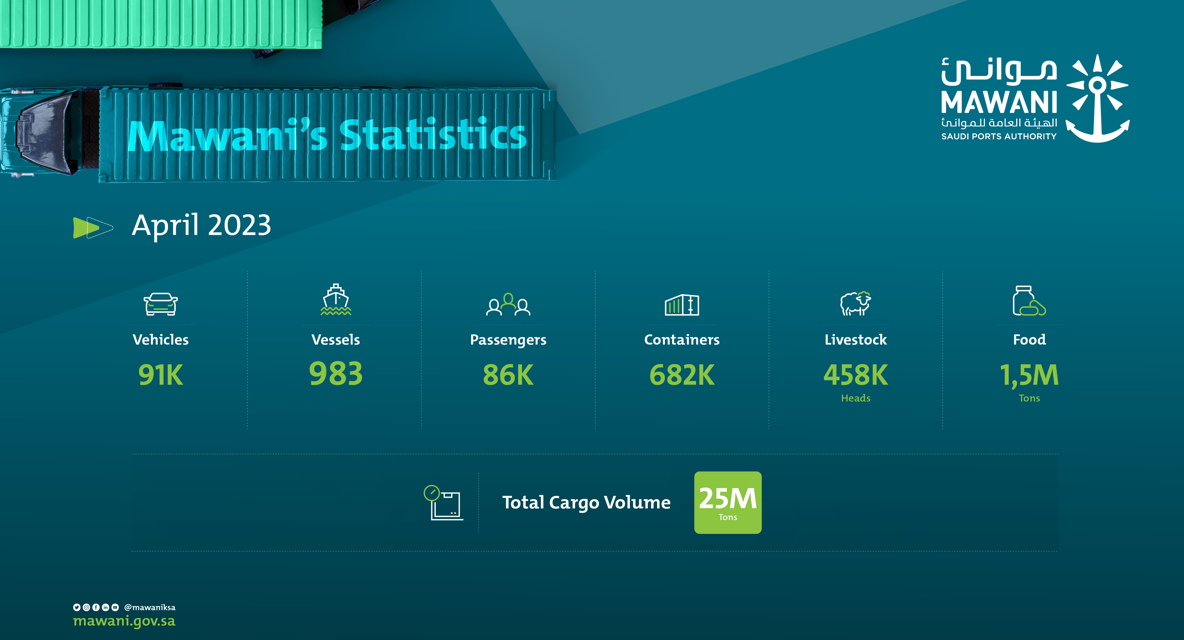
Saudi Ports Authority (MAWANI) announced that its container throughput in April 2023 grew at an annual rate of 13.34% from 601,429 TEUs to 681,663 TEUs as per monthly statistics.
Container data for last month further showed a 16.97% surge in exported volumes at 208,738 TEUs compared to 178,450 TEUs in the previous year. Imports have also inched up 3.12% to 208,080 TEUs from 201,784 TEUs this year with transshipments scoring 264,845 TEUs in April, a 19.73% increase year-on-year.
MAWANI has also revealed a 6.63% drop in cargo numbers at its ports, handling about 24,965,999 tons in contrast to 26,737,416 tons a year earlier.
The total cargo count for April included around 543,496 tons of general cargo, 4,135,552 tons of dry bulk cargo, and 13,026,227 tons of liquid bulk cargo.
Additionally, a similar decrease was also witnessed across the trade of food commodities with a 1.26% fall from 1,533,118 tons in 2022 to 1,513,729 tons in 2023.
On the contrary, livestock figures climbed 2.63% from 446,539 to 458,280 cattle heads.
Automobile units passing through Mawani’s hubs in April 2023 were estimated at 91,083 vehicles, a sizable jump of 52.8% from the 2022 level of 59,608.
The country's ports also accommodated 983 vessels across its berths last month, a marginal uptick of 3.69% from 2022’s total of 948 vessels.
Source: Container News
Related News

10/06
2026
The update of the Wan Hai Bunker Surcharge (WBS) for Q3/2026 by Wan Hai Lines (WHL) aims to proactively manage operational costs amidst the continuous fluctuations in global oil prices, while complying with stringent clean fuel standards in international maritime transport. This periodic adjustment helps ensure the maintenance of service quality and the stability of shipping routes departing from key southern port clusters (Ho Chi Minh City, Dong Nai, Ba Ria - Vung Tau) to global markets.

05/05
2026
The revised surcharge will take effect from June 1, 2026 (based on gate-in date) and will remain applicable until further notice.

25/03
2026
The global aviation industry is facing a new wave of disruption as ongoing tensions in the Middle East continue to put pressure on jet fuel costs, flight operations, and the overall stability of international air networks. The impact is no longer limited to routes passing directly through conflict-affected areas. Instead, it is now spreading across multiple markets, driving higher airfares while also increasing the risk of flight delays and cancellations on a broader scale.