



Major container lines make history with US$41.6 billion earnings in 2022 Q2
Danish maritime analysis company Sea-Intelligence looked at the financial and volume results posted by the major container carriers for the second quarter of the year.
In terms of EBIT (Earnings Before Interest and Tax), the leading shipping lines recorded a combined EBIT of US$41.6 billion, except French carrier CMA CGM which has only issued a press release so far, which does not list their EBIT.
This is not only higher than the combined Q2 EBIT of the past 11 years but is also right at the top with the 2021-Q4 and 2022-Q1 EBIT; once CMA CGM’s EBIT is included in the list, 2022-Q2 would likely become the most profitable quarter in the last decade.
"We do not mean this as a value judgement on whether shipping lines making money is a good or a bad thing, and we note it has generally been an unprofitable business for the past decade or so; we are merely pointing out the unprecedented nature of the current market dynamics," noted Sea-Intelligence analysts.
The following figure shows the EBIT/TEU for the carriers that publish both their EBIT and their global volumes.
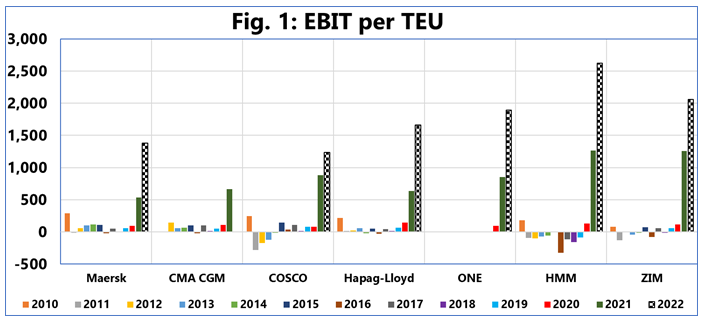
"The 2022-Q2 EBIT/TEU figure of each of these box lines dwarfs each of the previous years, with the latter hardly relevant in context of the outsized EBIT/TEU numbers that we are seeing right now," pointed out Sea-Intelligence in its report.
These figures are backed by a Y/Y increase in freight rates in 2022-Q2, according to the Danish maritime data firm.
However, Alan Murphy, CEO of Sea-Intelligence, believes that this level of profitability might not continue into the third quarter, due to the fast-falling freight rates, and the slowdown in global demand.
Source: Container News
Related News

10/06
2026
The update of the Wan Hai Bunker Surcharge (WBS) for Q3/2026 by Wan Hai Lines (WHL) aims to proactively manage operational costs amidst the continuous fluctuations in global oil prices, while complying with stringent clean fuel standards in international maritime transport. This periodic adjustment helps ensure the maintenance of service quality and the stability of shipping routes departing from key southern port clusters (Ho Chi Minh City, Dong Nai, Ba Ria - Vung Tau) to global markets.

05/05
2026
The revised surcharge will take effect from June 1, 2026 (based on gate-in date) and will remain applicable until further notice.

25/03
2026
The global aviation industry is facing a new wave of disruption as ongoing tensions in the Middle East continue to put pressure on jet fuel costs, flight operations, and the overall stability of international air networks. The impact is no longer limited to routes passing directly through conflict-affected areas. Instead, it is now spreading across multiple markets, driving higher airfares while also increasing the risk of flight delays and cancellations on a broader scale.