



ZIM profits over US$4.2 billion so far, while container volumes remain flat
The normalisation in container rates has begun, according to ZIM president and CEO, who noted that his company's third-quarter and nine-month results reflect "outstanding execution and elevated profitability".
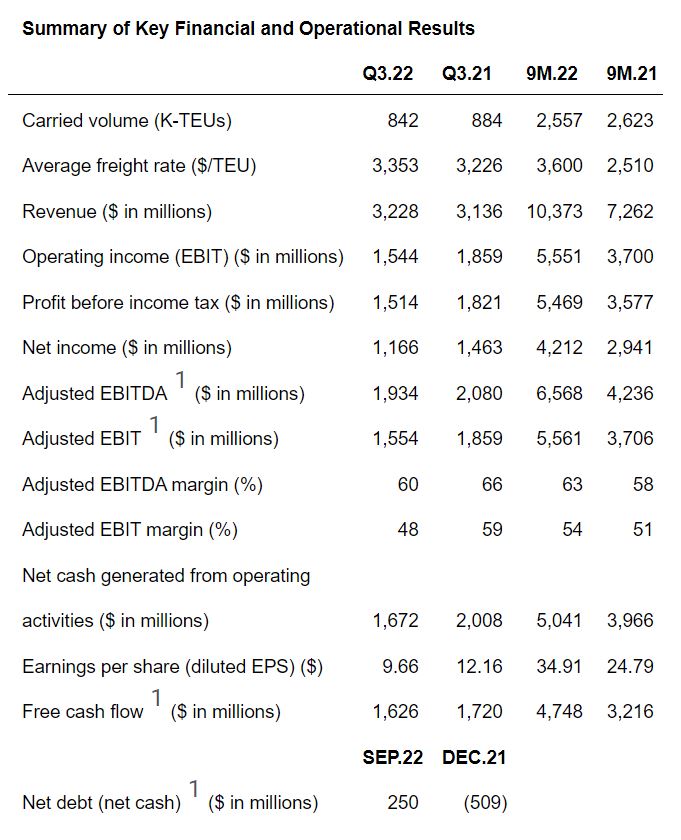
The Israeli container carrier reported US$1.17 billion in net income, US$1.93 billion in adjusted EBITDA and US$1.54 billion in operating income (EBIT) for the third quarter of the year. All these figures are significantly decreased compared with the same period in 2021.
For the period July-September 2022, ZIM's vessels moved 842,000 TEUs, representing a year-on-year drop of 5%. However, the average freight rate per TEU in the third quarter increased by 4% from 2021 same quarter to US$3,353. As a result, ZIM's revenues for the third quarter were US$3.23 billion, a year-over-year increase of 3%.
Additionally, for the first nine months of 2022, the Haifa-headquartered ocean carrier has achieved total revenues of US$10.37 billion, EBIT of US$5.5 billion, adjusted EBITDA of US$6.57 billion and net income of US$4.21 billion.
Moreover, ZIM has moved over 2.55 million TEUs from January to September 2022.
"Given our significant cash generation, and consistent with our prioritization of returning capital to shareholders, we have declared this year over US$1.26 billion, or US$10.55 per share, in dividends on account of 2022 results, including a Q3 dividend of approximately US$354 million, or US$2.95 per share," said Glickman.
ZIM's boss noted that the company now forecasts 2022 adjusted EBITDA of between US$7.4 billion to US$7.7 billion and adjusted EBIT of between US$6 billion to US$6.3 billion.
Source: Container News
Related News

10/06
2026
The update of the Wan Hai Bunker Surcharge (WBS) for Q3/2026 by Wan Hai Lines (WHL) aims to proactively manage operational costs amidst the continuous fluctuations in global oil prices, while complying with stringent clean fuel standards in international maritime transport. This periodic adjustment helps ensure the maintenance of service quality and the stability of shipping routes departing from key southern port clusters (Ho Chi Minh City, Dong Nai, Ba Ria - Vung Tau) to global markets.

05/05
2026
The revised surcharge will take effect from June 1, 2026 (based on gate-in date) and will remain applicable until further notice.

25/03
2026
The global aviation industry is facing a new wave of disruption as ongoing tensions in the Middle East continue to put pressure on jet fuel costs, flight operations, and the overall stability of international air networks. The impact is no longer limited to routes passing directly through conflict-affected areas. Instead, it is now spreading across multiple markets, driving higher airfares while also increasing the risk of flight delays and cancellations on a broader scale.