



Demand rebound loses some steam in April, reports Sea-Intelligence
Sea-Intelligence reported that in terms of TEU*Miles (which also accounts for the distance a container has to travel), there was a sharp 6-month growth reduction that reverted to "only" a minor level of growth decline in March 2023.

"This new trend continued in April as well, albeit somewhat less strong," noted the Danish maritime data analysis firm.
Sea-Intelligence analysts explained, "When we look at a cross plot of Y/Y demand growth in April 2023 against the share of global TEU*Miles for the global trades, we see that while the Far East to North America and Far East to Europe trades are substantially larger than the rest, the low North America imports are causing the growth decline."
This is corroborated by the fact that the TEU*Miles growth minus the Far East to North America trade rebounded to positive growth in March and stayed there in April 2023 as well, according to the report.
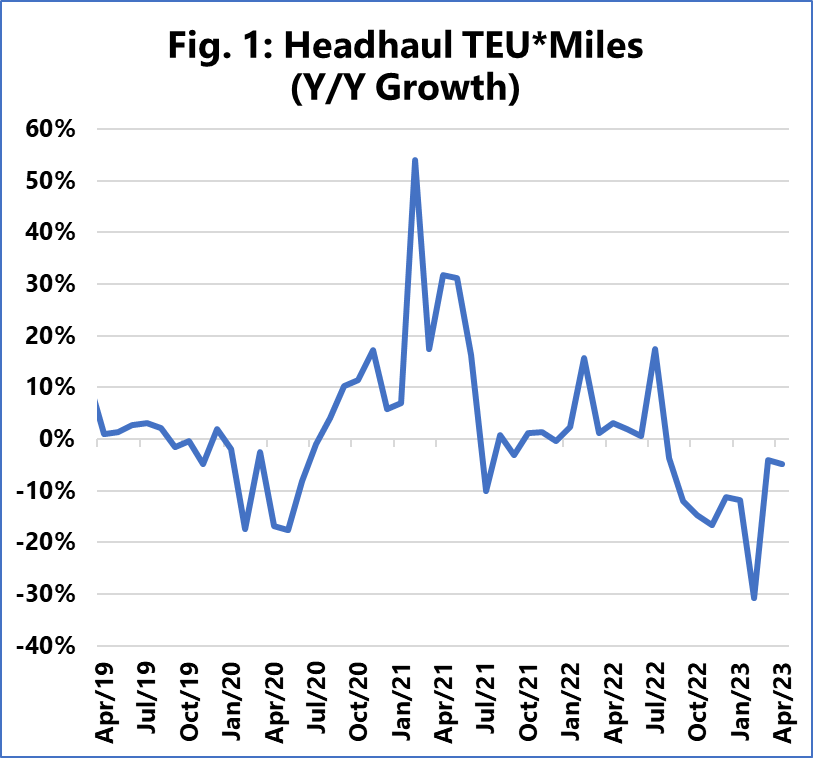
"However, as we know, because of the trade imbalances, it is the strength of the head-haul markets which is the true measure of whether the ships are full or not,” stated Alan Murphy CEO of Sea-Intelligence.
The figure depicts the Y/Y growth in head-haul TEU*Miles. As can be observed, the market recovery deteriorates slightly again in April. Once again, this is mostly due to the continued decline in the Far East to North America volume.
"This very poor performance should furthermore be seen in the context of the inventory developments in the US we covered in issue 617 of the Sunday Spotlight. Therein, it was clear that despite the drop in imports, inventory sizes were still not declining, which remains problematic," said Alan Murphy.
In essence, Sea-Intelligence sees a picture where global demand is indeed recovering in terms of growth rates, but with the trade to North America as well as key intra-regional trades, not being a part of this recovery.
Source: Container News
Related News

10/06
2026
The update of the Wan Hai Bunker Surcharge (WBS) for Q3/2026 by Wan Hai Lines (WHL) aims to proactively manage operational costs amidst the continuous fluctuations in global oil prices, while complying with stringent clean fuel standards in international maritime transport. This periodic adjustment helps ensure the maintenance of service quality and the stability of shipping routes departing from key southern port clusters (Ho Chi Minh City, Dong Nai, Ba Ria - Vung Tau) to global markets.

05/05
2026
The revised surcharge will take effect from June 1, 2026 (based on gate-in date) and will remain applicable until further notice.

25/03
2026
The global aviation industry is facing a new wave of disruption as ongoing tensions in the Middle East continue to put pressure on jet fuel costs, flight operations, and the overall stability of international air networks. The impact is no longer limited to routes passing directly through conflict-affected areas. Instead, it is now spreading across multiple markets, driving higher airfares while also increasing the risk of flight delays and cancellations on a broader scale.