



Gwangyang port and LG unit to create 5G container cranes
South Korea's Yeosu-Gwangyang Port Authority has signed a memorandum of understanding with compatriot cellular carrier LG Uplus Corp. to develop 5G remotely controlled container cranes, which will operate using multi-access edge computing (MEC) technology.
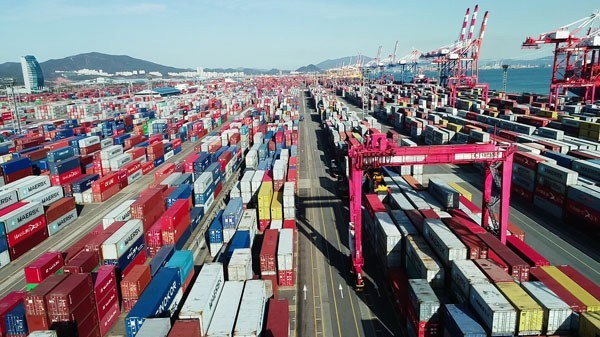
MEC technology allows pilots to control the container cranes from a cockpit far from the container yard, through cloud computing and 5G solution. Located in South Jeolla province, Gwangyang port, South Korea's second-busiest container hub after Busan, aims to position itself as a smart port.
Both sides will launch their collaboration with MEC and low-delay video transmission solutions to two rubber-tyred gantry cranes in Gwangyang port.
Through remote control, more containers can be moved and loading can be automated even when employees are taking their breaks, possibly elevating productivity by 40%. It also helps to improve the working environment for pilots who have to work for eight hours in the cockpit at an altitude of 25 metres.
LG Uplus, a unit of the LG chaebol, plans to build a 5G base station in the terminal and provide a communication environment that enables stable remote control by utilising the Gwangju MEC Centre.
The system will include a low-delay video transmission solution that reduces delay time by maximising ultra-high-capacity video compression. Combined with the 5G network and MEC, the delay time can be reduced to less than 100m/second and the video transmission time can be reduced by more than 84% compared to 4G technology.
The South Jeolla provincial administration plans to subsidise part of the costs so that investment from the private sector will not be needed.
Seo Jae-yong, managing director of LG Uplus' smart infrastructure unit, said that the company plans to expand its smart port business nationwide, having built a remote-controlled crane at Dongwon Pusan Container Terminal in Busan Port in May.
Martina Li
Asia Correspondent
Related News

10/06
2026
The update of the Wan Hai Bunker Surcharge (WBS) for Q3/2026 by Wan Hai Lines (WHL) aims to proactively manage operational costs amidst the continuous fluctuations in global oil prices, while complying with stringent clean fuel standards in international maritime transport. This periodic adjustment helps ensure the maintenance of service quality and the stability of shipping routes departing from key southern port clusters (Ho Chi Minh City, Dong Nai, Ba Ria - Vung Tau) to global markets.

05/05
2026
The revised surcharge will take effect from June 1, 2026 (based on gate-in date) and will remain applicable until further notice.

25/03
2026
The global aviation industry is facing a new wave of disruption as ongoing tensions in the Middle East continue to put pressure on jet fuel costs, flight operations, and the overall stability of international air networks. The impact is no longer limited to routes passing directly through conflict-affected areas. Instead, it is now spreading across multiple markets, driving higher airfares while also increasing the risk of flight delays and cancellations on a broader scale.