



Port Houston achieves new container record
Port Houston continues to break container records with total box volumes in August reaching 382,842 TEUs, which represents a 20% increase from the same month last year and the busiest month in the history of the port.
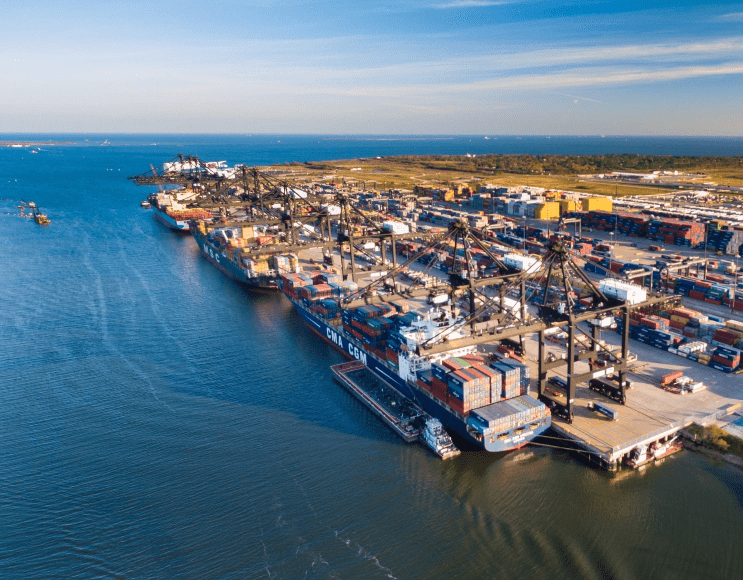
In total, Port Houston has handled 2,608,405 TEUs year-to-date, a 17% increase over last year’s record numbers.
Loaded container imports reached 180,132 TEUs, a 13% increase this year compared to last with the National Retail Federation’s Global Port Tracker recently reporting that through July import volume is up 21% at Port Houston and only 4% overall in the US.
“Port Houston is committed to meeting the challenge of historic cargo demand and providing a cost-efficient and vital gateway for America’s maritime cargo,” said Roger Guenther, executive director at Port Houston.
“We are expediting the development of container yard space and wharves, and are adding equipment like shipto-shore cranes and rubber-tired gantry cranesto maintain efficiency as we expand terminal capacity,” he added.
Port Houston noted that dwell is a challenge at Bayport and Barbours Cut terminals due to high container volumes. On average, import dwell has doubled and is now six days, compared to two or three in the past.
Port officials are exploring an Excessive Dwell Fee leveraged on containers that stay at the terminal longer than the free time outlined in the tariff.
The US port has also announced a recent addition of Saturday gates offering an option for importers to retrieve their containers from 08:00 to 17:00 (local time) every Saturday. “We are asking our customers to take advantage of these additional Saturday hours of service, pull your containers quickly, and consider adapting procedures to work with us toward the common end goal of efficiency throughout the supply chain,” said Guenther.
Source: Container News
Related News

10/06
2026
The update of the Wan Hai Bunker Surcharge (WBS) for Q3/2026 by Wan Hai Lines (WHL) aims to proactively manage operational costs amidst the continuous fluctuations in global oil prices, while complying with stringent clean fuel standards in international maritime transport. This periodic adjustment helps ensure the maintenance of service quality and the stability of shipping routes departing from key southern port clusters (Ho Chi Minh City, Dong Nai, Ba Ria - Vung Tau) to global markets.

05/05
2026
The revised surcharge will take effect from June 1, 2026 (based on gate-in date) and will remain applicable until further notice.

25/03
2026
The global aviation industry is facing a new wave of disruption as ongoing tensions in the Middle East continue to put pressure on jet fuel costs, flight operations, and the overall stability of international air networks. The impact is no longer limited to routes passing directly through conflict-affected areas. Instead, it is now spreading across multiple markets, driving higher airfares while also increasing the risk of flight delays and cancellations on a broader scale.