



Schedule reliability drops to record-low in January 2022
Schedule reliability dropped again, this time by 0.9 percentage points, month-to-month to 30.9%. This is the lowest ever global schedule reliability since the Danish research and analysis company Sea-Intelligence started the measure in 2011.
On a year-to-year level, schedule reliability was down by 3.8 percentage points, according to Sea-Intelligence's report.
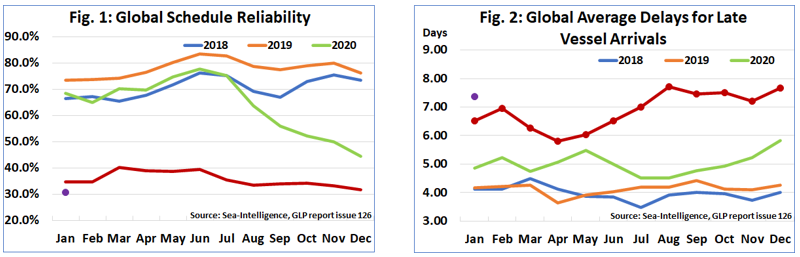
"Despite the low schedule reliability since January 2021, there hasn’t been much fluctuation, with the global scores largely between 30%-40%," said CEO of Sea-Intelligence, Alan Murphy, who added that the average delay for late vessel arrivals decreased slightly to 7.38 days, the sixth consecutive month with the delay figure above 7 days.
|
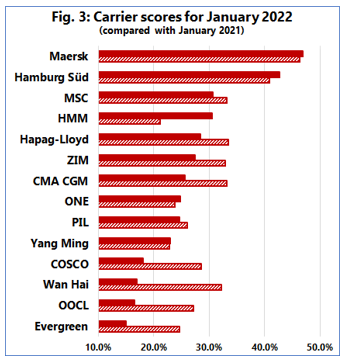
According to the latest issue of Sea-Intelligence's Global Liner Performance (GLP) report, Maersk was once again the most reliable top-14 carrier in January 2022, with schedule reliability of 46.9%, followed by its subsidiary Hamburg Süd with 42.8%. MSC and HMM had schedule reliability between 30%-40%, with six carriers recording schedule reliability of 20%-30%. The remaining four carriers had schedule reliability of under 20%, with Evergreen recording the lowest January 2022 schedule reliability figure of 15%. At the same time, ten carriers recorded a month-to-month improvement in schedule reliability, while five carriers recorded a year-to-year improvement in schedule reliability, with only three carriers recording double-digit Y/Y declines. |
 |
Source: Container News
Related News

10/06
2026
The update of the Wan Hai Bunker Surcharge (WBS) for Q3/2026 by Wan Hai Lines (WHL) aims to proactively manage operational costs amidst the continuous fluctuations in global oil prices, while complying with stringent clean fuel standards in international maritime transport. This periodic adjustment helps ensure the maintenance of service quality and the stability of shipping routes departing from key southern port clusters (Ho Chi Minh City, Dong Nai, Ba Ria - Vung Tau) to global markets.

05/05
2026
The revised surcharge will take effect from June 1, 2026 (based on gate-in date) and will remain applicable until further notice.

25/03
2026
The global aviation industry is facing a new wave of disruption as ongoing tensions in the Middle East continue to put pressure on jet fuel costs, flight operations, and the overall stability of international air networks. The impact is no longer limited to routes passing directly through conflict-affected areas. Instead, it is now spreading across multiple markets, driving higher airfares while also increasing the risk of flight delays and cancellations on a broader scale.