



Seaport container handling fees to be adjusted from mid-February 2024
The Ministry of Transport has recently issued a circular on seaport services fees, including cargo loading and unloading fees.
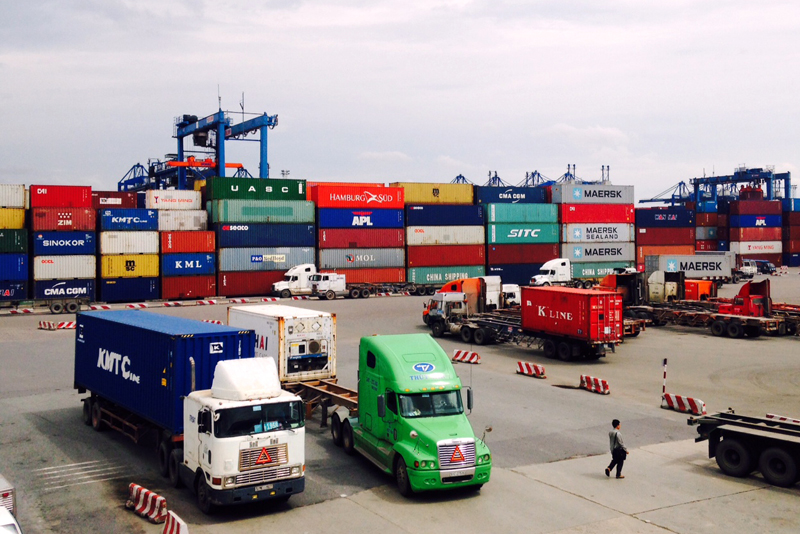
The Ministry of Transport has recently issued a circular on seaport services fees, including cargo loading and unloading fees.
Accordingly, the fees range from 260,000 VND (10.67 USD) to 427,000 VND for each domestic 20-foot container, from 439,000 VND to 627,000 VND per 40-foot container, and from 658,000 VND to 940,000 VND per more than 40-foot container.
The fees for imported, exported, temporarily imported and re-exported containers are between 23 USD and 81 USD, depending on the types of container.
For oversized and overloaded cargo containers, and those with dangerous goods, or special loading, unloading, and preservation requirements that incur additional costs, the applicable fees will not exceed 150% of the prescribed price bracket.
Circular No. 39/2023/TT-BGTVT will take effect from February 15, 2024, applicable to Vietnamese organisations and inpiduals and foreign organisations and inpiduals related to the provision and use of services at Vietnamese seaports.
According to the Vietnam Maritime Administration (Vinamarine), Vietnam’s container loading and unloading charges remain lower than the regional average.
Vinamarine's statistics show that the loading and unloading charges at deep-water seaports in Vietnam are equivalent to just 59% of those in the ASEAN region and neighbouring countries, and 85% of Phnompenh Port, Cambodia – an inland port with a lower investment value.
Increasing container handling fees, a major part of terminal handling charges (THCs), is reasonable to help ports secure resources for reinvestment, expansion, and enhancing service quality, according to Vinamarine.
Source: Customs News
Related News

10/06
2026
The update of the Wan Hai Bunker Surcharge (WBS) for Q3/2026 by Wan Hai Lines (WHL) aims to proactively manage operational costs amidst the continuous fluctuations in global oil prices, while complying with stringent clean fuel standards in international maritime transport. This periodic adjustment helps ensure the maintenance of service quality and the stability of shipping routes departing from key southern port clusters (Ho Chi Minh City, Dong Nai, Ba Ria - Vung Tau) to global markets.

05/05
2026
The revised surcharge will take effect from June 1, 2026 (based on gate-in date) and will remain applicable until further notice.

25/03
2026
The global aviation industry is facing a new wave of disruption as ongoing tensions in the Middle East continue to put pressure on jet fuel costs, flight operations, and the overall stability of international air networks. The impact is no longer limited to routes passing directly through conflict-affected areas. Instead, it is now spreading across multiple markets, driving higher airfares while also increasing the risk of flight delays and cancellations on a broader scale.