



Vessel utilisation remains low, reports Sea-Intelligence
Danish shipping data analysis company Sea-Intelligence reports that global demand continues to decline, and whether we calculate the growth in TEU*Miles or as an annualised percentage over 2019, the supply/demand balance is under pressure.
The latest demand data from Container Trade Statistics (CTS) shows that in August 2022, the annualised growth over 2019 was below the level seen in 2019, which means that unless carriers reduce capacity substantially, vessel utilisation will be low.
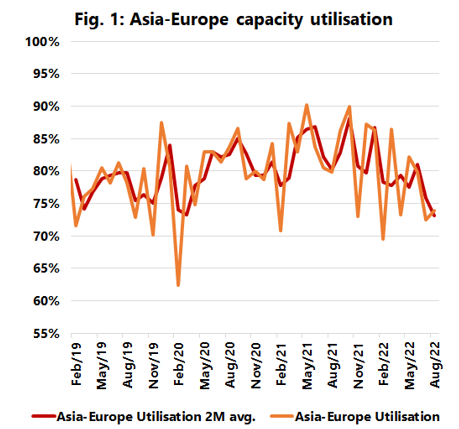
"As we have shown several times in Sea-Intelligence the Sunday Spotlight, to maintain the ultra-high spot rate levels, a nominal utilisation in excess of 92%-93% needs to be sustained on the Transpacific, with the threshold on Asia-Europe being 85%," noted the analysts.
They went on to explain, "On the Transpacific, utilisation dropped below 90% for much of 2022, becoming a catalyst for the continued freight rate drop. In August, utilisation crossed the 90% mark, but only just, still falling short of the 92% threshold to indicate a rate increase."
In Asia-Europe, utilisation has been dropping even further, according to the analysts. "As we can see in figure 1, 2022 utilisation on Asia-Europe has been consistently below the 85% threshold to trigger a rate increase, and although the utilisation improved in August to 74% from 72% in July, the rolling 2-month average saw a further decline from 76% to 73%," they said.
Alan Murphy, CEO of Sea-Intelligence, commented, "This latest data simply reconfirms what has been the case since Spring 2022, i.e. there is no underlying structural support for the high rates on Transpacific and Asia-Europe."
Source: Container News
Related News

10/06
2026
The update of the Wan Hai Bunker Surcharge (WBS) for Q3/2026 by Wan Hai Lines (WHL) aims to proactively manage operational costs amidst the continuous fluctuations in global oil prices, while complying with stringent clean fuel standards in international maritime transport. This periodic adjustment helps ensure the maintenance of service quality and the stability of shipping routes departing from key southern port clusters (Ho Chi Minh City, Dong Nai, Ba Ria - Vung Tau) to global markets.

05/05
2026
The revised surcharge will take effect from June 1, 2026 (based on gate-in date) and will remain applicable until further notice.

25/03
2026
The global aviation industry is facing a new wave of disruption as ongoing tensions in the Middle East continue to put pressure on jet fuel costs, flight operations, and the overall stability of international air networks. The impact is no longer limited to routes passing directly through conflict-affected areas. Instead, it is now spreading across multiple markets, driving higher airfares while also increasing the risk of flight delays and cancellations on a broader scale.